
Rashed Haq
Rashed Haq is a Bangladeshi-American artist, technologist and writer. He uses a combination of AI and photography in his artistic practice. He has recently had over 50 solo and group exhibitions across North America. He was awarded the Art+Science award from Lenscratch, and the COMPAS Photography award from Oxford University. His works are included in the permanent collections of The Museum of Fine Arts Houston and The Grace Museum, among various private and corporate collections.
Activation Studies
I. Steering and II. Transference
Digital prints on aluminum
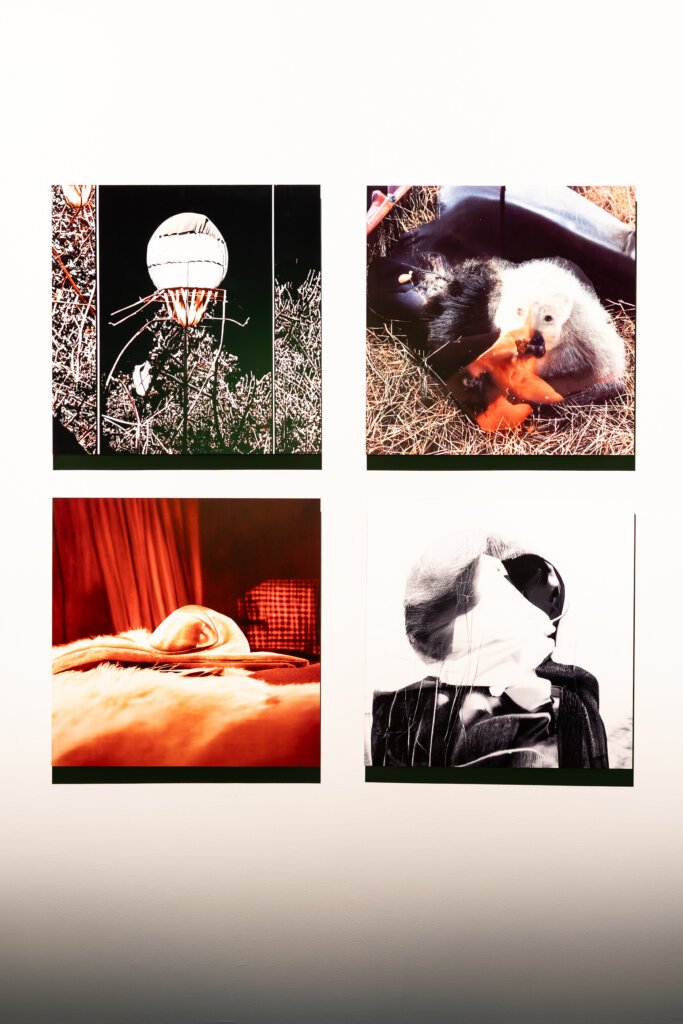
Conversations about AI-generated images often revolve around language, for example, what a model “understands” from a prompt, how phrasing shapes a picture. But the prompt is only the surface. Beneath it sits a vast interior structure that words never touch: the model’s own way of organizing what it has learned to see.
The four images of Steering were made without a single word. Rashed Haq recorded the internal activity of a large open-source diffusion model as it generated images with no prompt, then trained a second, smaller network to break that activity down into individual directions, each tied to something the model has learned but language does not name. The smaller network makes no images of its own. Instead, Haq applies a chosen direction as a gentle nudge at every step of the diffusion model’s usual process, from noise through roughly fifty rounds of refinement. Because there is no prompt, there is no destination. The nudge leans toward a concept the model already holds, but nothing tells it what to make of that concept. Haq describes this as “steering into the unknown, with a hand on the wheel and no map, watching what the model builds when it is pushed but never pointed.”
Transference inverts the method. One image generation receives a prompt, and its activity is recorded at every layer and every step. A second image generation, given no prompt of its own, is continually corrected toward that recording. Sometimes it arrives almost where the first one did. Sometimes its own momentum and the borrowed direction pull against each other, and the image comes apart. All of this ran on clusters of NVIDIA H100 GPUs in Modal’s cloud, where recording, mapping, and testing the model’s interior far outweighed the making of any single picture. Together, the works in Activation Studies ask what becomes of an image when the hand guiding it knows nothing, and what becomes of it when that hand knows everything but isn’t the one imagining. What lies past the prompt is not emptiness but an enormous, unnamed vocabulary, and these images might be read as field notes from inside it.
