Grayson Earle
Grayson Earle is a contemporary artist and tactical media practitioner from the United States, based in Berlin. His diverse technological practice is unified by a political approach to media arts. His work examines the role that digital technologies and networks play in resistance and political agency, with sustained attention to labor and surveillance, frequently intervening in real world spaces and systems.
He is a member of The Illuminator, a guerrilla projection collective, and the creator of Bail Bloc, a software project that mined cryptocurrency to post bail for low-income people in New York City. His film Why don’t the cops fight each other? dissects the source code governing police behavior in video games and has screened at the Singapore Art Museum, KW Institute for Contemporary Art, and the Australian Centre for the Moving Image, and was an awardee of the 17th Busan International Video Art Festival.
Embracing an interdisciplinary posture, Earle has taught programming and new media as a professor at Oberlin College, Parsons School of Design, The New School, and the City College of New York. He has held residencies at Akademie Schloss Solitude, Pioneer Works, and BPA// Berlin program for artists, and has presented research and artist talks at The Magnum Foundation, The Vera List Center, and Theorizing the Web. He is currently the technical advisor for the Web Residency program at Akademie Schloss Solitude and a scholarship recipient in Critical Philosophy at the New Centre for Research & Practice.
00100
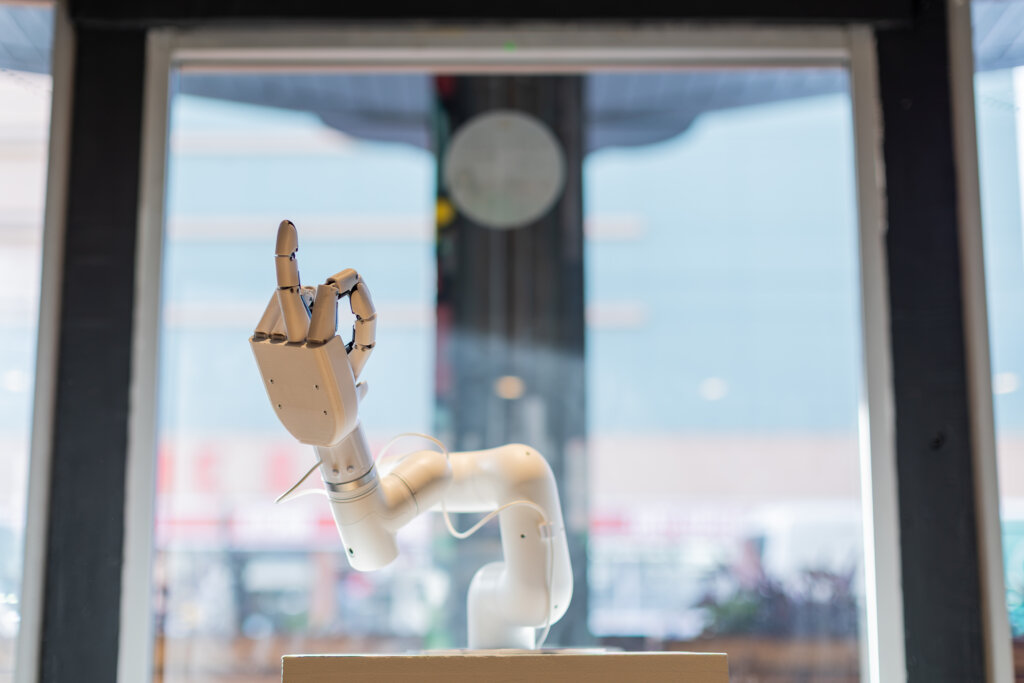
Interactive kinetic sculpture: collaborative robot arm, robotic hand, webcam, custom software
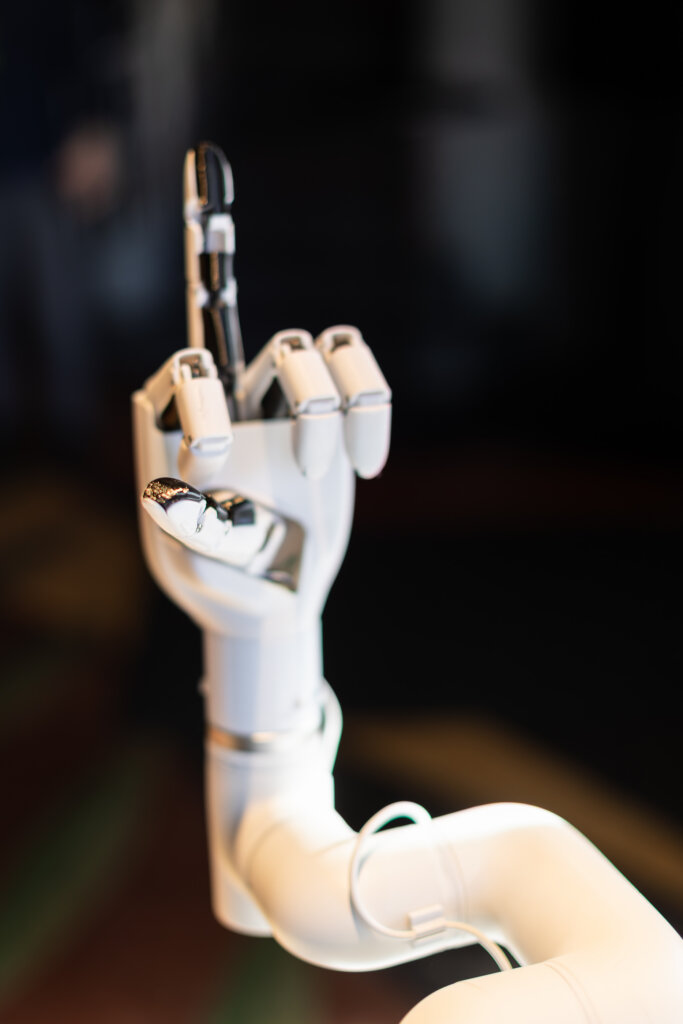
The machine in Gray Area’s front window belongs to a class known as collaborative robots, or cobots, designed to work safely alongside people in factories, laboratories, and classrooms. Their selling point is cooperation. Grayson Earle has fitted this one with a humanoid left hand and given it a single task: when its camera detects someone passing, the arm turns to find them and raises its middle finger.
Earle trained the arm in simulation on Modal’s cloud, where a virtual twin studied photographs of history’s most notorious middle fingers, from a baseball pitcher in 1886 to Johnny Cash at San Quentin, and refined its pose until it matched each one. On the robot itself, a small neural network picks out people in the camera’s view and keeps the hand aimed at the nearest. Around the corner, a vertical video plays on a monitor stripped down to its metal frame. It shows the robot’s twin learning each gesture, intercut with a 2,400-year history of the middle finger.
The gesture is crude by design. Collaborative robots are marketed on their deference, and the camera that tracks each passerby belongs to the same family of tools that turns public life into data. Earle, whose work has long examined how technology shapes labor, surveillance, and resistance, inverts both. A machine built for compliance performs one of the oldest gestures of refusal, aimed with computational precision at whoever happens to walk by. Many visitors will answer it with a selfie, completing the circuit: a camera watching a robot watching a person, all of it bound for the network.
00100 arrives amid a broader shift in how the Bay Area thinks about robotics. Since 2025, humanoid fight clubs have drawn crowds to San Francisco warehouses, nightclubs, and a former mattress showroom on Van Ness Avenue, where machines marketed as tomorrow’s general-purpose workers trade punches (and lately blades) under the control of human pilots. These spectacles share an impulse with Earle’s sculpture: to take machines built for service and cast them in the roles their makers least intended, as brawler, provocateur, or delinquent. Part of the pleasure of watching a robot misbehave is the pleasure of seeing through a sales pitch. Each disobedient machine makes plain what the promise of compliance tends to obscure: a robot’s conduct always expresses someone’s intent, and the question worth asking is whose.