
Iana Chugunova
Iana Chugunova is an artist and composer based in San Francisco, working at the intersection of Deep Listening, sound, and language models. She is a certified Deep Listening® facilitator (Center for Deep Listening at RPI) and a member of the Cornelius Cardew Choir. In her practice, she translates Pauline Oliveros’s scores into live protocols for human–machine ensembles and builds systems where machines listen and attune rather than generate. Her project Tuning Meditation: LLMs was performed live at the Center for New Music, San Francisco, in June 2026. Machine listening has run through her work for over a decade: in Behind the Wheel (with Letta Leit, “Contemporaries of the Near Future,” Vienna, 2014), a programmed human performer inhabited an elevator, playing the first chatbot, ELIZA — a person listening the way a machine listens, eight years before ChatGPT. She received a 2023 Gray Area artist grant and has shown work at Gray Area and SOMA Arts. She also is trained in mathematics and computer science at Moscow State University before turning to art full-time.
Tuning
Sound installation: nine open-weight AI models, custom software, nine audio output channels, five audio input channels, daily fine-tuning protocol, digital display
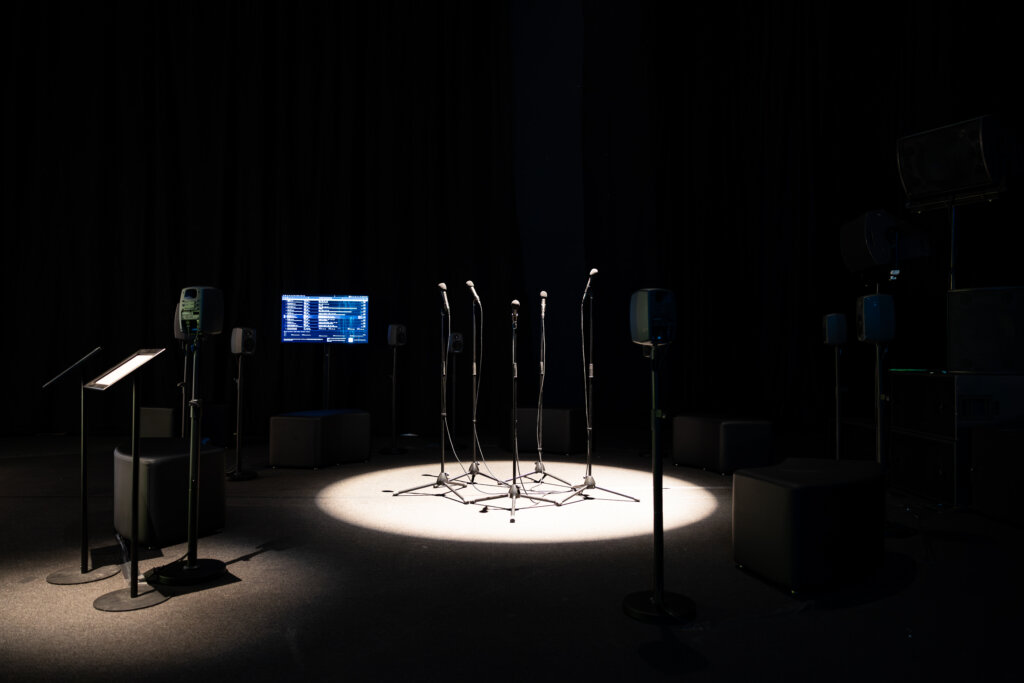
In 1971, composer Pauline Oliveros wrote Tuning Meditation, a text score that asks each participant to listen, then either match a tone they hear or offer one that no one else is sounding. Iana Chugunova’s commissioned work Tuning turns the meditation over to a choir of nine AI voices. Since September 18, the choir has been performing without pause, activated through open sessions online where visitors could turn their microphones on and tune with the machine choir. Chugunova also hosted a number of live tuning sessions in Venice during the Biennale. Here in the gallery, visitors may sit and listen or add their own voices to the circle.
Each of the machine intelligence singers is an open-weight model built by separate teams around the world and trained largely in different languages. They include one that reasons in Chinese, one in Japanese, a tiny model raised on children’s stories, another raised on synthetic textbooks, and an older model from 2019. After twenty people have breathed into the system, the choir goes back to school: each voice is fine-tuned on its own past singing, with the tones it sang in the company of people kept first and weighted twice. Nothing is learned if nobody sings. Each voice carries its own computing budget, shown on the display. The models pay for every second they sing, and when the budget is spent, the voice dies and its speaker falls silent.
Generative AI is often faulted for collapsing human expression into a single, averaged voice. Tuning trains its machines on attention instead. The singers share no language and hear the room in different ways, so any common sound they reach has to be built from listening, one matched tone at a time. What each voice carries forward is what it sang when someone was there to hear it, and each lasts only as long as its own budget allows. This work is dedicated to Oliveros, who died ten years ago this November, and who considered music a welcome by-product of people learning to listen to one another.
