
Ira Greenberg
Ira Greenberg is an artist, author, and educator working at the intersection of painting, code, and computational systems. Trained as a painter (BFA, Cornell University; MFA, University of Pennsylvania), he began building procedural and generative systems in the 1990s and wrote Processing: Creative Coding and Computational Art, the first major book on the Processing language, followed by further texts on creative coding. As a professor at Southern Methodist University he founded and directed the Center of Creative Computation, one of the first academic programs to treat code as a fine-art medium. Since 2003 his ongoing Protobytes series has investigated artificial lifeforms built from hand-written mathematics–trigonometric surfaces, custom soft-body physics, and D’Arcy Thompson’s morphological transformations coded from scratch. The work has been exhibited and collected internationally, including through Gazelli Art House, Bright Moments, Braindrops, Expanded Art Feral File, and Verse. He is currently the sole builder of ij8.ai, a full-stack AI art and creative-coding studio platform –multi-model orchestration, image-to-3D and automated rigging pipelines, and generative audio infrastructure he now turns back on his own two-decade artificial-life practice.
Protobyte Phylogeny
Interactive installation: custom software, continuous cloud-based evolutionary simulation, vision-language and language models, generative audio, projection, three data displays, touchscreen breeding station
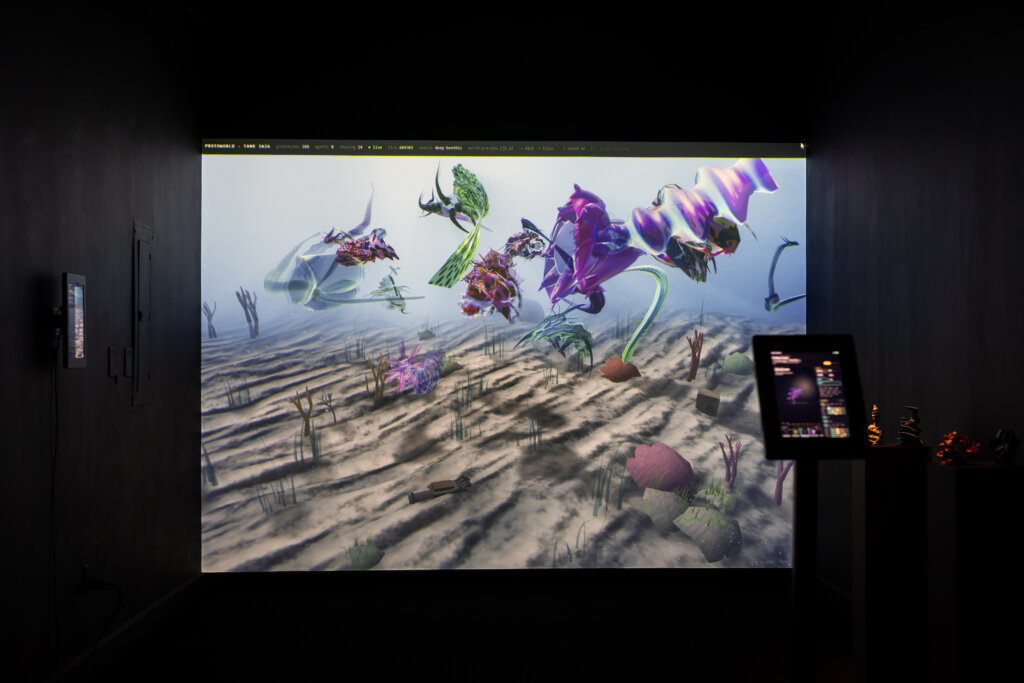
Ira Greenberg’s Protobytes are artificial life forms grown from code and mathematics. He began them in 2003 as two-dimensional drawing routines in ActionScript. Today each body grows from a genome of 61 numbers, which set everything from its superformula cross-sections to coordinate warps after D’Arcy Thompson, the biologist whose On Growth and Form showed that the shapes of related species could be drawn as deformations of a single grid. Greenberg wrote the code by hand for decades. The engine running here was written by AI coding models under his direction: he designs the system and judges the results by eye, and the code itself is now an implementation detail.
In ProtoWorld, the simulated environment at the heart of the installation, the Protobytes stop being renderings and become residents: a population that is born, competes, breeds, and dies around the clock in Modal’s cloud, whether or not anyone is in the room. At the breeding station, visitors make a creature, setting its genes or breeding it from others, and release it. Within about a minute it descends onto the projected wall, and every lineage here begins with one of these releases. Up to 288 creatures live at once, and the wall shows twenty-four at a time. Each earns energy by how well its body suits one of three ecological niches and spends it on metabolism, aging, and breeding. The favored niche changes every ten minutes, so no single body plan wins for long.
Fitness is judged in two parts. Eighty percent is how closely a creature’s genes match its niche’s ideal, as Greenberg defined it. Twenty percent comes from a vision-language model that looks at a portrait of each new creature and scores how well its body answers the niche. Language models act as resident naturalists: they read each creature’s traits and life record and write its specimen label, field note, and obituary.
The work extends a lineage of artworks conceived as living systems. In Christa Sommerer and Laurent Mignonneau’s A-Volve (1994), shown at Yerba Buena Center for the Arts in 1997, visitors drew creatures that swam, hunted, and mated in a pool of real water, and the artists described the audience as a mechanism of selection. Three decades later, the pool has moved into the cloud, the same infrastructure that increasingly sorts, names, and selects so much else in contemporary life.
No image model ever draws these creatures; every body on every screen is rendered from its genome. AI plays other roles: it collaborated on the program, it is one judge within the environment, and it keeps the record. Charles Darwin built his theory of natural selection by analogy to animal breeding, imagining selection without anyone doing the choosing. Protobyte Phylogeny brings both figures into one room: visitors breed by preference, the environment selects by pressure, and neither wrests full control. Against the fear that AI will flatten culture into sameness, this work offers a system whose product is variation itself.
