Will Gardiner
Will Gardiner is a technologist and systems thinker whose practice explores how computation can deepen our relationship with the living world. Combining geospatial technologies, environmental sensing, machine learning, and interactive media, he creates tools and experiences that reveal hidden ecological processes and invite new ways of seeing and understanding the landscapes around us. Grounded in systems thinking and open collaboration, his practice asks how technology can cultivate ecological understanding, stewardship, and a deeper connection with the more-than-human world.
What is it like to be a river?
Colin O’Donnell, Justine Sun Dela Cruz, and Will Gardiner
with Gavin Aiken & Lily O’Donnell
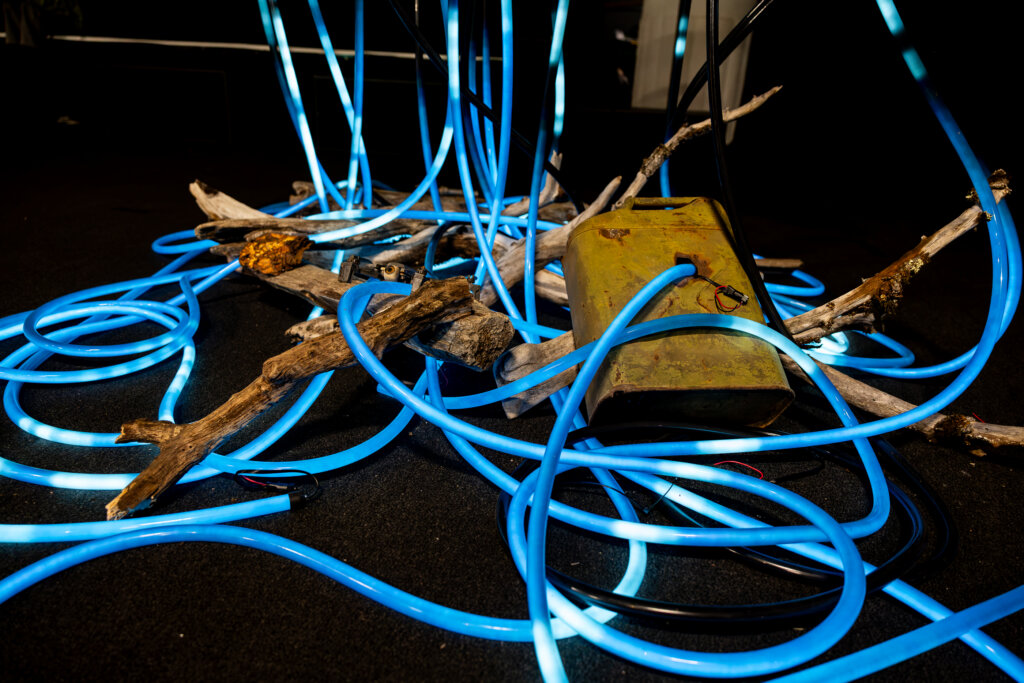
Networked installation: environmental sensors, custom software, machine learning models, LED tubing, touchscreen display
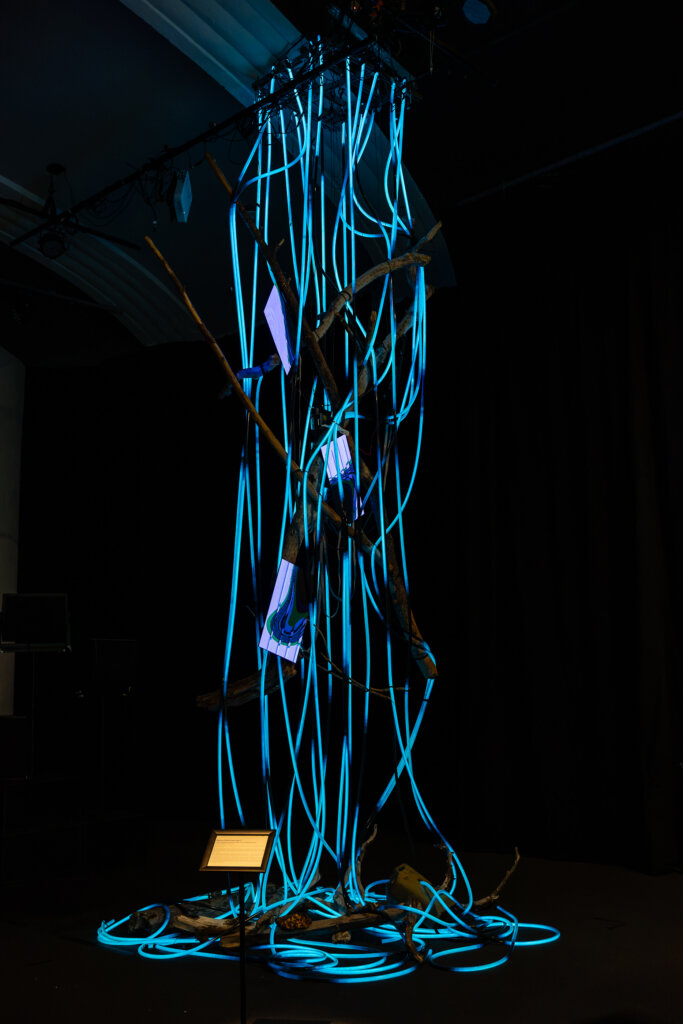
In 1974, the philosopher Thomas Nagel asked what it is like to be a bat, arguing that another creature’s inner life may lie beyond our understanding no matter how well we know its body. This interactive LED installation explores Nagel’s question through Dry Creek, a fast-moving tributary of the Yuba River in the Sierra Nevada foothills, some 150 miles from Gray Area.
Sensors placed along the creek and at Gray Area feed a model of the river that runs continuously on Modal’s cloud infrastructure. Rather than converting each measurement into a matching output, the model maintains an internal state of its own, and that state drives the imagery in the gallery, closing a loop between the gallery and the river.
The artists also draw on the developmental biologist Michael Levin, whose research finds intelligence in cells, tissues, and collectives operating far outside human scales of time and space. AI takes the role of interpreter, holding the river’s seasonal rhythms and the passing gestures of visitors within a single shared state. Nagel doubted we could ever know what another being’s experience is like, and Dry Creek, swelling with winter rain and thinning through the dry months, may never tell us. Still, for the length of the exhibition, the river and the people who visit it are in contact, each leaving its mark on the other.