
SF Cinematheque Presents:
J. Hoberman: Everything Is Now
Film and culture critic J. Hoberman discusses his latest book, with film screenings exploring the radical art, music, film and countercultural movements of 1960s NYC.
SF Cinematheque:
J. Hoberman: Everything Is Now
Friday, October 3, 2025
Doors: 7:00 PM
All Ages
Seated Screening + Discussion
View our FAQ page for more info, or contact us at [email protected] with any accommodation requests.
About the Event
J. Hoberman writes authoritatively on harmolodic jazz, censored comedians, the Fluxus art movement, experimental film, immersive theater, political protest and the birth of rap. Some of these stories—the emergence of Bob Dylan, for instance—are oft told. But our guide through these subterranean blues knows all the craziest, twisted tales and where the bodies are buried: The underground newspaper taken over by its female staffers. The midnight screenings shut down by the police. The jazz pioneer found drowned in a river… Everything has everyone—Hoberman is encyclopedic in his recounting of the breakthroughs, breakdowns and bombings. It’s a performer- and performance-driven narrative, vividly told.
— (New York Times)
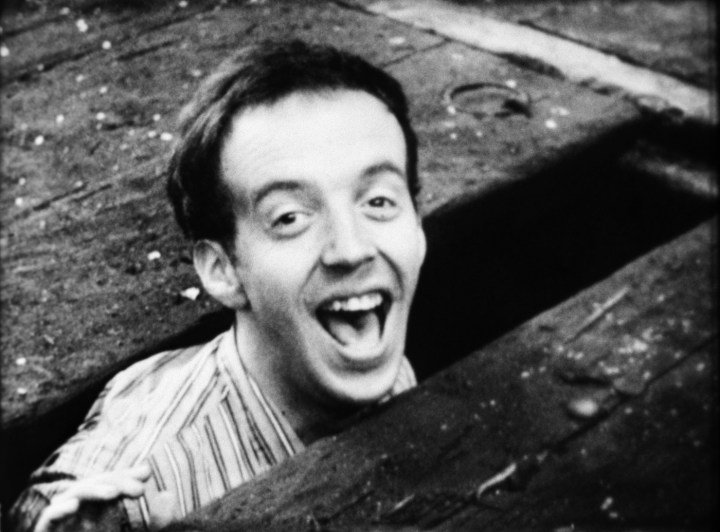
J. Hoberman was, for more than three decades, film and culture critic for the Village Voice and is known for extensive writing on mainstream and underground film. Hoberman’s latest work, Everything Is Now: The 1960s New York Avant-Garde—Primal Happenings, Underground Movies, Radical Pop is a veritable underground explosion, chronicling Beat culture; avant-garde jazz; performance art, theater and happenings; political radicalism and agit-prop; psychedelic rock; pop art and more. In celebration of this fascinating chronicle of this turbulent and transformational decade, SF Cinematheque is thrilled to welcome J. Hoberman in person, to discuss the book and present Ron Rice’s shambling Beat masterpiece The Flower Thief (1960)—a film shot in late-1950s San Francisco documenting the crumbling glamour of the city’s North Beach environs and starring underground cinema’s first true star, the irrepressible Taylor Mead—preceded by Scotch Tape (1959–1962), a three-minute blast of entropic ecstasy filmed by Jack Smith on the rubble strewn site of the future Lincoln Center, NYC. Both films screened in 16mm!
About Everything is Now
Like Paris in the 1920s, New York City in the 1960s was a cauldron of avant-garde ferment and artistic innovation. Boundaries were transgressed and new forms created. Drawing on interviews, memoirs and the alternative press, Everything Is Now chronicles this collective drama as it was played out in coffeehouses, bars, lofts, storefront theaters and, ultimately, the streets. The principals here are penniless filmmakers, jazz musicians and performing poets, as well as less classifiable artists. Most were outsiders at the time. They include Amiri Baraka, Bob Dylan, Allen Ginsberg, Yayoi Kusama, Yoko Ono, Nam June Paik, Carolee Schneemann, Jack Smith, Andy Warhol and more. Some were associated with specific movements (Avant Rock, Destruction Art, Fluxus, Free Jazz, Guerrilla Theater, Happenings, Mimeographed Zines, Pop Art, Protest-Folk, Ridiculous Theater, Stand-Up Poetry, Underground Comix and Underground Movies). But there were also movements of one. Their art, rooted in the detritus and excitement of urban life, was taboo-breaking and confrontational. As J. Hoberman shows in this riveting history, these subcultures coalesced into a counterculture that changed the city, the country and the world.
Copies of Everything Is Now will be available at the screening and are also available here.
J. Hoberman also appears October 1 at Berkeley Art Museum/Pacific Film Archive (details here) and October 2 at the Mechanics Institute, San Francisco (details here).
Screening
Scotch Tape (1952–1962) by Jack Smith
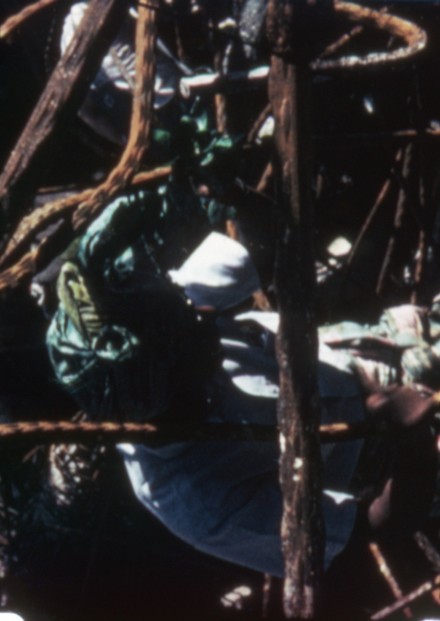
Jack Smith’s first released movie is an apparently edited-in-camera 100-foot roll of Kodachrome II shot in 1959, using Ken Jacob’s 16mm Bell & Howell at […] the rubble-strewn site of the future Lincoln Center on Manhattan’s west side. Despite its brevity, Scotch Tape anticipates the epic quality of Smith’s subsequent films and theater pieces. […] Jacobs, who appears in the film, frantically dancing and mugging along with […] performer Jerry Sims, proposed that Smith call his film Reveling in the Dumps and even drew titles. Instead, Smith chose to name his movie after the dirty piece of stickum that had wedged out in the upper right corner of the frame. (J. Hoberman)
The Flower Thief (1960) by Ron Rice
“North Beach had been under fire for the better part of two years. In May 1958, The San Francisco Examiner ran a three-part exposé of the Beat Generation’s ‘headquarters’ and the sinister antics occurring ‘far outside the faceless jungle of nothingness.’ […Taylor] Mead imagined The Flower Thief as the scene’s ‘death knell,’ a pensive eulogy. In his memoir, he wrote that [Ron] Rice thought of him “wandering through various locations, some in the process of being torn down and associating with the last twenty or so genuine intellectual wastrels in the area.” In any case, the look was proudly primitive. Rice used outdated film army-surplus 16mm film to document Mead’s arbitrary tour of San Francisco’s bohemian quarter. Mead was impressed with Rice’s energy. […] Affect alternating between the wistfully infantile and dementedly fey, frequently dragging an outsized teddy bear in a child’s red wagon, Mead clowns around town. Sites range from jazz bars and downtown street corners to the beach-side Playland amusement park on San Francisco’s western edge and a vast derelict loft belonging to the scene’s frequently busted, 300-pound paterfamilias Eric “Big Daddy” Nord. Although nothing if not pre-sexual, Mead appears to find love, picked up by a good-looking kid in the film’s final sequence […]. To call The Flower Thief self-indulgent is to state the obvious—and miss the point. Unscripted and genuinely haphazard, filled with goofy non sequiturs, less talented than persistent, The Flower Thief was something like the scene’s home movie…” (J. Hoberman: Everything Is Now)
Partners

San Francisco Cinematheque
Founded in 1961, San Francisco Cinematheque cultivates the international field of non-commercial artist-made cinema through curated exhibitions, through the creation of publications and by maintaining a publicly accessible research archive. Cinematheque’s work inspires aesthetic dialog between artists, stimulates critical discourse, and encourages appreciation of artist-made cinema across the broader cultural landscape. With a grounding in non-commercial, non-narrative and non-documentary filmmaking traditions, Cinematheque’s programs broaden the public’s understanding of non-mainstream artistic filmmaking practice while expanding and challenging established art- and film historical traditions.

Become a Gray Area Member
As a Gray Area Member you get special access to events, behind-the-scenes content and more. Gray Area is a dedicated family of supporters who believe in the power of creative action to catalyze social transformation. Join as a member today to provide sustaining support for our globally unique arts, education, research, and incubation programs.
