

SF Cinematheque Presents:
Larry Gottheim: Mnemosyne + Tree of Knowledge
A rare screening of two mid-period masterworks by avant-garde filmmaker Larry Gottheim, exploring time, memory, and perception through experimental cinema.
SF Cinematheque:
Larry Gottheim: Mnemosyne + Tree of Knowledge
Thursday, November 6, 2025
Doors: 7:00 PM
All Ages
Seated Screening + Discussion
View our FAQ page for more info, or contact us at [email protected] with any accommodation requests.
About the Event:
Working in film since the late 1960s, the cinema of avant-garde filmmaker Larry Gottheim is an observational cinema, rewarding contemplation, stillness, and active intellectual engagement, and offering uncannily commonplace imagery rife with elusive metaphor and/or accumulating into densely immersive conceptual conundra. In Gottheim’s films, time slows, hesitates, and seems to move in novel and non-linear directions, the circularity of experience a recurring aspect of the master filmmaker’s rich body of work. Gottheim’s recent book, The Red Thread: Larry Gottheim and His Films (published 2024 by Eyewash Books and the Film-Makers’ Cooperative) is a ruminative and musing career-spanning culmination, teasing out longitudinal threads and uncanny occurrences in the oeuvre, presenting the artist’s body of work as a multi-faceted whole, a throughline of thought and material-based philosophy.
In celebration of this publication, San Francisco Cinematheque is honored to present a three-program residency (in partnership with the Roxie Theater, Gray Area, and Shapeshifters Cinema, Oakland) presenting selections from the artist’s vast body of work, from early single-shot films, still lifes, and nature studies to the complex sound/image constructions of later work to the very recent films completed 2019–2024.
Cinematheque’s centerpiece program at Gray Area features two mid-period masterworks which confound the linear experience of time through complex reversals, repetitions, and elaborate restructurings of sound/image relationships, films in which time runs backward and forwards at the same time, reflective films pondering paranoia, remembrance, grief, childhood, and aging.
Screening:
Mnemosyne Mother of Muses (1986),
Tree of Knowledge (Elective Affinities, Part 4) (1980) by Larry Gottheim.
Program presented by San Francisco Cinematheque. Programs one and three at the Roxie Theater, SF and Shapeshifters Cinema, Oakland. Full details here.
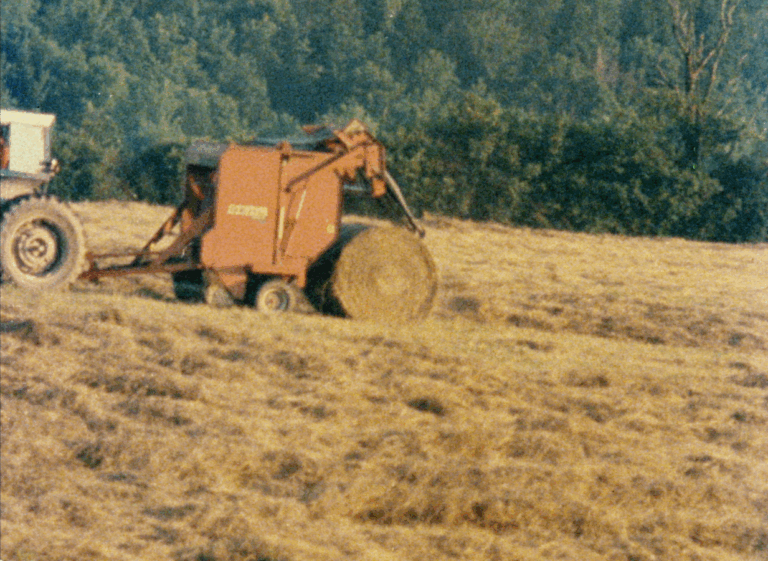
Mnemosyne Mother of Muses (1986)
There is a double retrograde motion. A flow of images goes forward, linked to a sound track that is going backward. Then the directions are reversed. This relates to the complex canon forms and retrograde motions that were beloved of some Western Renaissance composers as well as Schoenberg and Webern. I was influenced by a passage in Heidegger where he calls attention to the ancient Greeks conceiving Mnemosyne, the goddess of memory, as the mother of the muses. Memory is both a subject of the film and an essential part of its structure. The material evokes many other emotional and philosophical ideas. Images include those from a wedding, the Red Robin Diner at night, my father after his stroke, the place in Sunnyside where I grew up, a ruined factory on the shore in Eastport, Maine. Sound elements include the conductor Arturo Toscanini rehearsing a passage from Wagner, something from the sound track of the film noir The Killers (1946, dir. Robert Siodmak). There is a sense of loss and recovery. The need to go back and its impossibility except in art.
— Larry Gottheim

Tree of Knowledge (Elective Affinities, Part 4) (1980)
The final film of the Elective Affinities series (1973–1980). A central element is a documentary film about paranoid conditions. Another is a flow of images of an apple tree in my back yard filmed impulsively, without forethought, the opposite of the static camera of Fog Line (1970). The radical breaking with the previous passivity of the camera has deep psychological dimensions. That was the first thing that led me to bring the paranoid material into the zone of the tree footage. The elements of sound and image are closely matched to each other, frame by frame. Inserted in them at the heart of the film are images of children, Kenneth and Louise, from an instructional documentary about the seasons. Cries of cattle being auctioned and sent to the stockyards are also inserted. The children are central. They stand in for the audience of the didactic film about the seasons. They are both the ones who are learning and also part of the didactic mechanics of that film that represents and teaches received knowledge. The paranoid patients are also presented as instruments of instruction and at the same time subjects themselves who have absorbed in a distorted way knowledge they have received from religion, newspapers, common gossip. Their minds struggle with elements of the outside world that penetrate their attention—politics, new post-WWII technologies. The doctor who presents them is also in intimate league with them in this studio space. The narrator of the seasons film is his brother. The affinities between all these figures continue the theme of doubles that appear in my films. The film points to a deeper reality than what is on the surface. The explanation of the seasons is obviously correct. But in its didactic context it serves as a cover for something deeper. This material is repeated with different permutations of the sound material and the image material, once in the original sync sound and again with the other sound track, continuing procedures from the preceding two films of the series. All this is preceded and followed by continuous black and white negative images of the tree going from clear to black and reversed at the end. Each is accompanied by an important sound element. At the very beginning and end is a small piece with new material that points forward and back into a world outside the garden, that concludes the series of Elective Affinities and opens to new procedures…
— Larry Gottheim
Partners

San Francisco Cinematheque
Founded in 1961, San Francisco Cinematheque cultivates the international field of non-commercial artist-made cinema through curated exhibitions, through the creation of publications and by maintaining a publicly accessible research archive. Cinematheque’s work inspires aesthetic dialog between artists, stimulates critical discourse, and encourages appreciation of artist-made cinema across the broader cultural landscape. With a grounding in non-commercial, non-narrative and non-documentary filmmaking traditions, Cinematheque’s programs broaden the public’s understanding of non-mainstream artistic filmmaking practice while expanding and challenging established art- and film historical traditions.
The Roxie Theater
The Roxie Theater, a San Francisco landmark in the Mission District, brings people together to meet and connect through distinctive cinematic experiences. Guided by the passionate belief that engaging with a movie doesn’t end with the credits, we invite filmmakers, curators, entertainers and educators to interact with our audiences. We provide inspiration and opportunity for the next generation, and serve as a forum for the independent film community reflecting the spirit of the diverse Bay Area population.
Shapeshifters Cinema
Shapeshifters Cinema provides a venue and support for contemporary artists working with experimental and artist-made film, video, sound, music and other types of mediated performance. We host screenings and performances by local and visiting artists in our intimate 40-seat theatre and offer workshops on a variety of experimental and DIY moving image and sound production. Our storefront shop specializes in print publications, DVDs, sound recordings and other kinds of media made by artists who have screened or performed in our venue.
Become a Gray Area Member
As a Gray Area Member you get special access to events, behind-the-scenes content and more. Gray Area is a dedicated family of supporters who believe in the power of creative action to catalyze social transformation. Join as a member today to provide sustaining support for our globally unique arts, education, research, and incubation programs.
