
Barry Threw and Scott Moore
San Francisco, CA—November 21, 2025
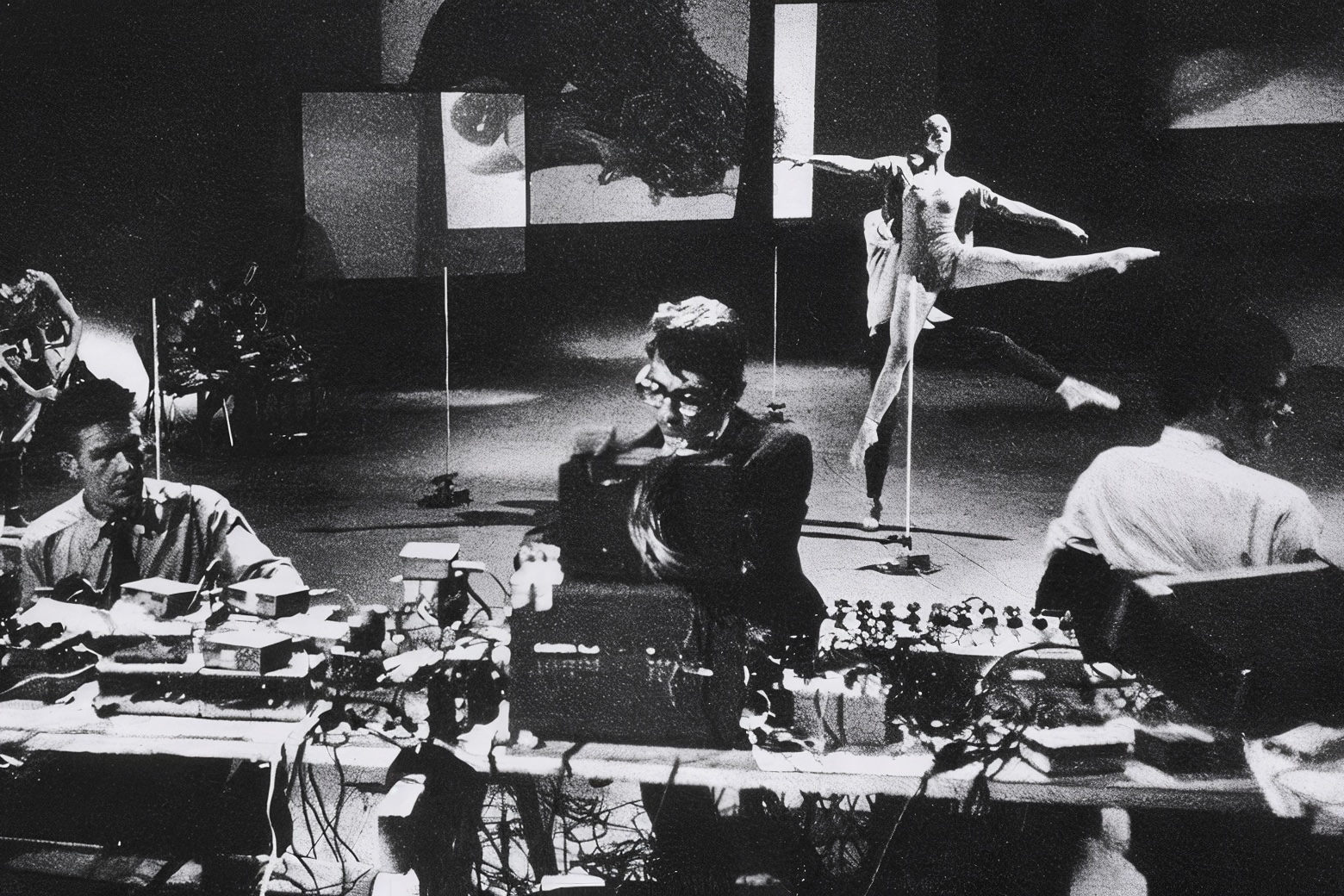
In 1966, Billy Klüver stood before an audience at the 69th Regiment Armory in New York City. Behind him, Robert Rauschenberg’s Oracle emitted electronic sounds that pulsed with artificial life. Surrounding them, a chorus of nine other artists and thirty engineers from Bell Labs had assembled “9 Evenings: Theatre and Engineering”, the first performance to wield the quiet magic of Doppler sonar, video projection, and wireless sound transmission. It was a show that the art world had never witnessed, and that would mark the beginning of Klüver’s now renowned Experiments in Art and Technology (E.A.T.).
Klüver understood the significance of the venue he chose. Half a century earlier, the same venue had hosted the 1913 International Exhibition of Modern Art, the fabled “Armory Show” that first introduced Americans to the modernist revolutions of Europe. To its audience, the Cubist geometries of Picasso and the colors of Matisse were glimpses of the visual language of an industrial future. In the same way, Klüver wanted to introduce his audience to a digital one.
On the West Coast, a similar energy was powering the cultural engine that would become Silicon Valley. In 1969, with Cybernetic Serendipity, Jasia Reichardt’s groundbreaking exhibition of computer art, algorithmic music, and interactive devices transformed Frank Oppenheimer’s San Francisco interactive science museum called the Exploratorium into a space where rituals of play and wonder collided with the machinery of computation. Gordon Pask made conversational mobiles that learned and adapted through feedback, turning light and motion into an evolving dialogue; Nam June Paik’s sculptures used assemblages of televisions, metal parts, and everyday objects to reflect on identity and memory; John Cage’s computer-generated compositions showed how algorithms and chance could force composers to contend with serendipity. Each piece was carefully included to form an exhibition that dealt with “possibilities rather than achievements” at a time where the intersection of art and technology had yet to be formalized.
Experiments continued to thrive throughout the following decades. At Xerox PARC, residencies with artists like Harold Cohen and Richard Shoup showcased graphical interfaces, input instruments, and other interactive metaphors that would come to define the personal computer era. At the Portola Institute, Stewart Brand published the first edition of the Whole Earth Catalog, a mail-order compendium that taught its readers how to wire solar panels, build geodesic domes, and program Hewlett-Packard calculators. At Esalen, a retreat center in Big Sur that launched the Human Potential Movement, engineers and programmers joined Gestalt therapists and Zen teachers in workshops where meditation and sensory deprivation were treated as parallel experiments in human operating systems.
All of these experiments enshrined technology as more than just advanced engineering but a medium of expression. Like McLuhan, they saw technology as an extension of our nervous system, and as his contemporary Ivan Illich might have said, they were fundamentally convivial: inviting improvisation, learning, and communal construction. They proved that when used together in collective practice, art and technology could help us explore the human condition. In doing so, they created not only new laboratories but new cathedrals, where the impulse toward invention became inseparable from the search for the divine.
