TIAT, which contracts four paid part-time gallery attendants, is supported by a rotating group of over 80 volunteers. Herr, who dedicates her full time to TIAT, wants to pay all artists, though that currently depends on whether an exhibition has sponsors — something most shows have lacked.
“Every arts organization is struggling right now with top-level budget cuts, with government funding and whatnot,” Herr said. “We aren’t supported by any big foundation, and there’s no billionaire funding us.”
Beyond Vacant to Vibrant, Herr credits ticketed events, workshops, residencies, incubators, event rentals and grants for sustaining the organization. TIAT also offers a $55-per-month membership that includes event admission, gallery coworking (normally $10 per day), a one-time merchandise redemption and an optional website shout-out.
From a cultural perspective, Tran said he sees creative technology as a “counterculture” to artificial intelligence and optimization, the trends currently ascendant in the tech community.
But that position isn’t always understood from the outside. Tran said he recalled someone once asking him — aggressively, he felt — whether his art was being used to train AI. He said those who think that, or are reflexively critical of TIAT, probably don’t know what it’s actually doing.
Halim Madi, a San Francisco-based computational poet, said any criticism he receives isn’t about his art but the medium.
“Often the critiques are just that technology is bad, technology drains your attention or technology is bad for society,” he said. “All of these are ideas that have calcified. The invitation of all creative technologists is to show a more complex picture.”
One of Madi’s works is a browser-based instrument to which audience members submit words, which are then assembled into a poem that modulates the performer’s voice via a synthesizer. The piece premiered at TIAT in January.
Madi said he sees his work at the gallery as part of a broader effort by creative technologists to reclaim technology from pure utility and the mundane.
“The gift of the artist is to make us reconsider, make us pause and sit with the things that we have taken for granted,” he said.
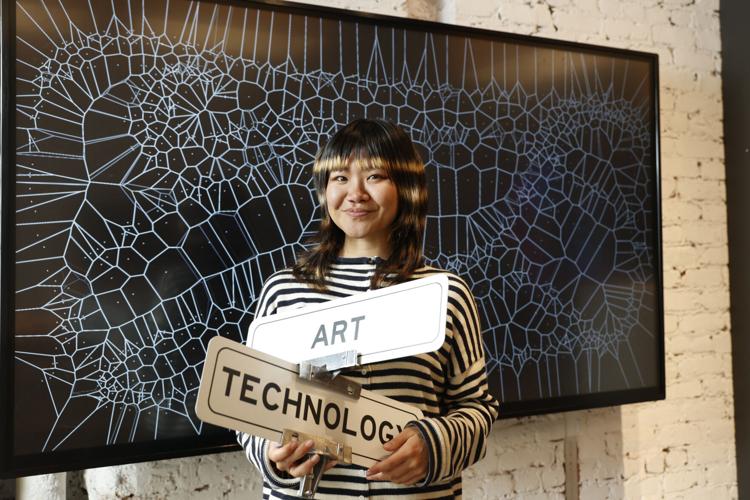
Meshi expressed a similar view. Much of her art practice, she said, is about “inviting people to spend time with the technology, and then provoking more thoughts in relation to it.”
One of Meshi’s works is an arm-worn device that listens to what someone is saying to her, generates a GPT response and whispers it into her ear, which she then repeats to the other person as if the words were her own.
While TIAT’s downtown space provides a home for artists such as Madi and Meshi, and reflects real demand for the events and opportunities it offers, it might be part of a cycle that’s unsustainable.
‘If San Francisco is going to be a great city, I hope that it is measured by the greatness of its equity.’
- Charles Collins
Barry Threw, executive and artistic director at Gray Area, has seen this cycle before: downtown real-estate collapses, people questioning what to do and deciding to bring in artists to prop up the value. Short-term programs for arts organizations follow, the value of the area rises — and those organizations are then priced out because they don’t have ownership or equity and are forced to relocate.
Instead, Threw said, the solution requires a coordinated long-term commitment across city government, public and private companies, and foundations. He said he wants San Francisco to treat cultural sustainability “seriously as the economic driver for the city that it is,” with a plan that considers the next 100 years.
“For pocket change for a lot of these companies, we could have the most vibrant cultural scene on Earth in San Francisco,” he said.
Civic leader Charles Collins, the president of the San Francisco Arts Commission and a member of the SFMOMA board, also said Vacant to Vibrant is not the long-term solution that’s necessary, although it’s a vital first step.
He said the initiative’s action should extend beyond downtown to neighborhoods such as Parkmerced and Bayview-Hunter’s Point.
“If San Francisco is going to be a great city, I hope that it is measured by the greatness of its equity,” Collins said.
Even though Vacant to Vibrant isn’t the sole reason TIAT is still operating — as proven by its success amid its nomadic past — the revitalization program has accelerated the nonprofit’s maturation and given its creative technologists a new place to call home.
“If it stops, it would be — for me — a sign of deterioration of the city.” Meshi said of the gallery’s uncertain future. “I always hope for more, and TIAT has been giving me that more.”