
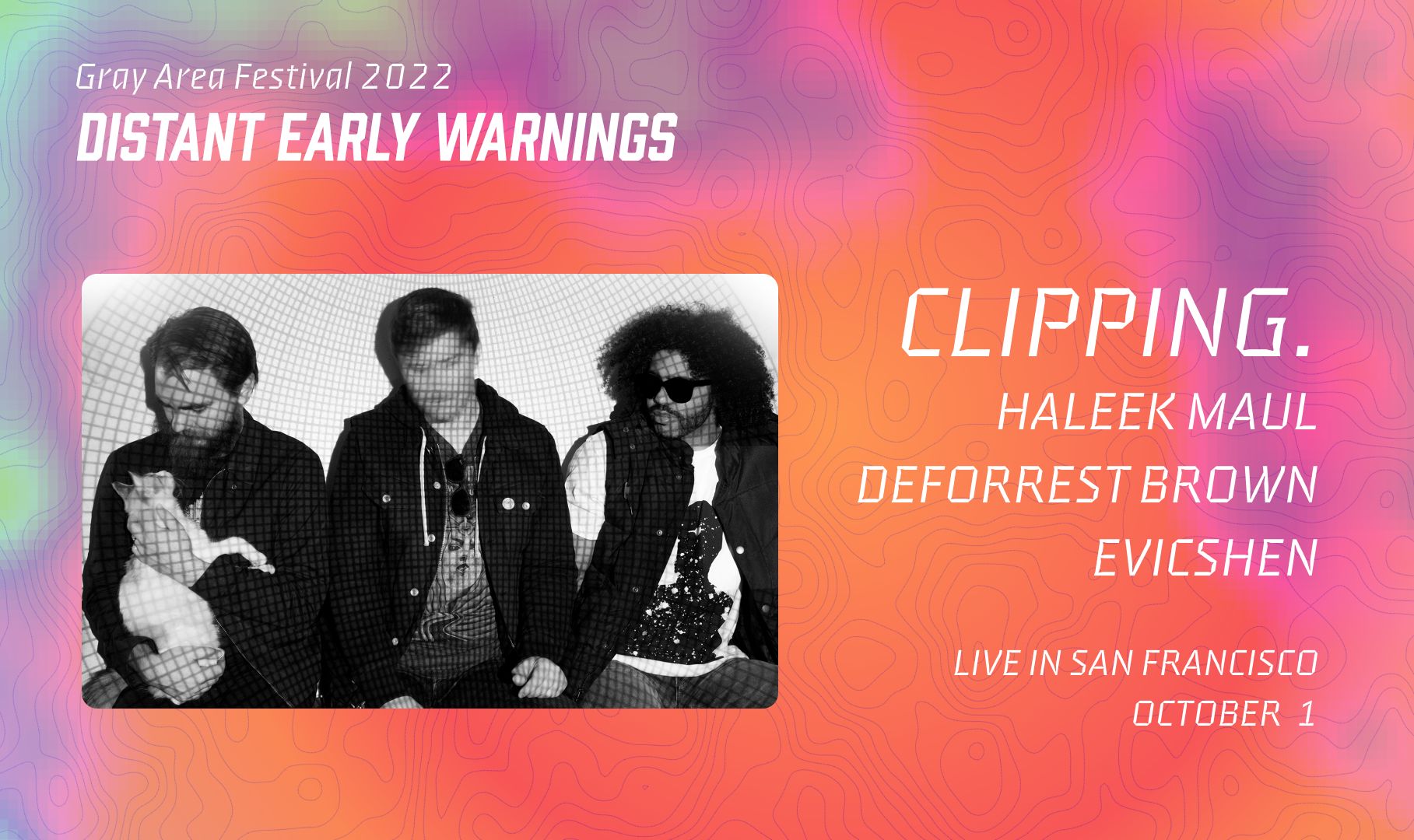
clipping.Gray Area Festival Performances
Join us in celebrating the closing night of Gray Area Festival 2022 with clipping., Haleek Maul, DeForrest Brown and Evicshen, four dynamic and unique performances bridging experimental, hip-hop, horrorcore, and electronic music.
Get access to our performances, conference talks, and exhibition with the Gray Area Festival Pass, or attend each night of performances with individual tickets.
Gray Area Festival Performance
Clipping.
Haleek Maul
DeForrest Brown
Evicshen
Saturday, October 1, 9pm – 1am
Audiovisual Concert
18+
$15-30
Gray Area
2665 Mission Street,
San Francisco
Proof of vaccination is required for all attendees over 12 years of age. Learn more
View our FAQ page for more info, or contact us at [email protected] with your accommodation requests.

clipping.
clipping. is an American experimental hip-hop group from Los Angeles, California. The group consists of rapper Daveed Diggs and producers William Hutson and Jonathan Snipes. The group began in 2009 as a remix project, with Hutson and Snipes taking a cappellas of mainstream rap artists and making power electronics and noise remixes of them to amuse themselves. Diggs joined in 2010 and began to write his own raps over their compositions and the group self-released their first album, midcity, in 2013. The group has drawn comparisons to the likes of Dälek, Death Grips, My Bloody Valentine, Tim Hecker and Shabazz Palaces. The Guardian described their sound as “the sort of shrill thrills you imagine could function as incidental soundtrack music for a documentary about abattoirs or might conceivably be the work of a young band intent on twisting industrial metal into brutal new shapes. With rapping on top.” Rolling Stone called them “[n]imble-tongued, beat-fractured L.A. hip-hop spilled over the abrasive crunches, squeals, clangs, slurps, and static of experimental musique concrète.” As part of their experimental style, the band adhere to certain stylistic limitations. Their instrumentation is derived from real world samples (e.g. using recordings of bottles being hit or bricks breaking) instead of traditional instruments. Similarly, Diggs writes his rap in second person, all ‘I, me’ language is off limits.
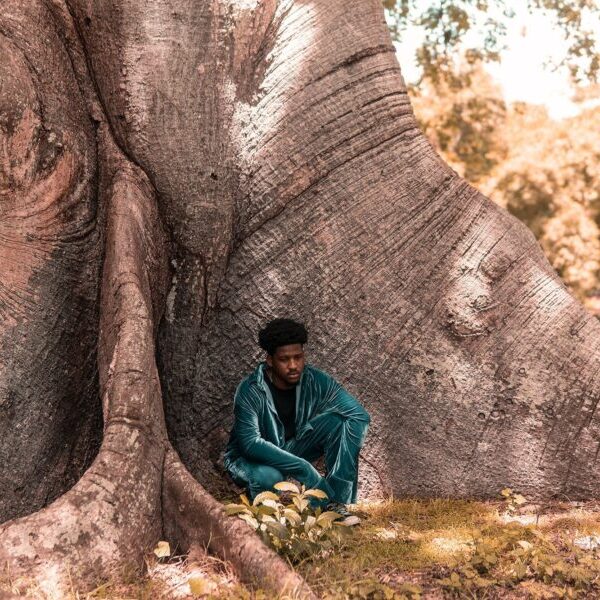
Haleek Maul
Haleek Maul is an American rapper, record producer, and a founding member of the collective On the Tanz. He has collaborated with the likes of Deniro Farrar, Shady Blaze, Hot Sugar, and Saul Williams. Noisey has described him as “the new hustler of horrorcore”. In 2012 at age 16, Haleek Maul released his debut EP Oxyconteen which Spin named “Rap Release of the Week”, and Fact placed it at number 48 on the “50 Best Albums of 2012” list. In that year, he also released a collaborative mixtape with Chicago production duo Supreme Cuts, titled Chrome Lips, which Clash included it on the “Top 10 Mixtapes of the Year” list. He released a mixtape, Prince Midas, in 2015, an EP, In Permanence, in 2018, and his debut solo studio album, Errol, in 2020.
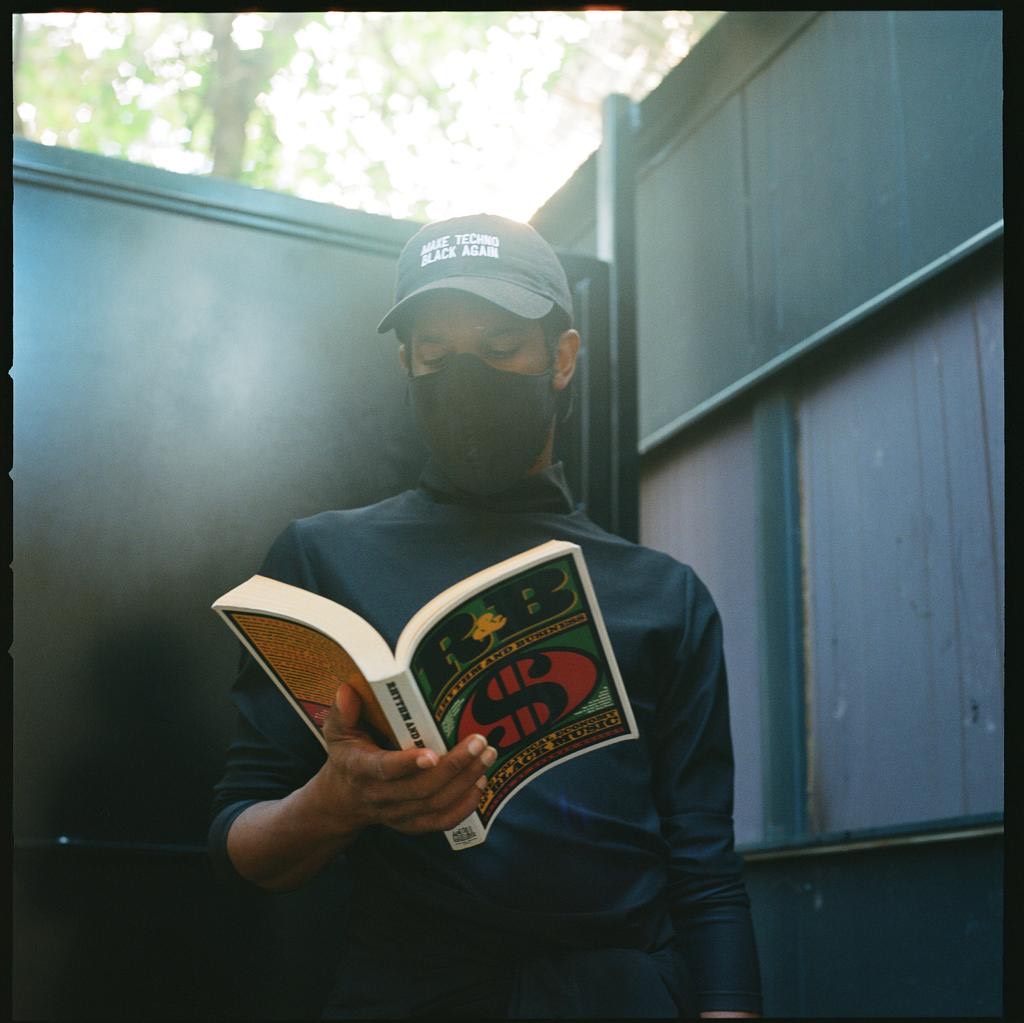
DeForrest Brown
DeForrest Brown, Jr. is an Alabama-raised, Ex-American rhythmanalyst, writer, and representative of the Make Techno Black Again campaign. As Speaker Music, he channels the African American modernist tradition of rhythm and soul music as an intellectual site and sound of generational trauma. On Juneteenth of 2020, he released the album Black Nationalist Sonic Weaponry on Planet Mu. His written work explores the links between the Black experience in industrialized labor systems and Black innovation in electronic music, and has appeared in Artforum, Triple Canopy, NPR, CTM Festival, Mixmag, among many others. He has performed or presented work at Haus der Kulturen der Welt, Berlin; Camden Arts Centre, UK; Unsound Festival, Krakow; Sónar, Barcelona; Issue Project Room, New York; and elsewhere. Assembling a Black Counter Culture is Brown’s debut book.

Evicshen
Evicshen is a cross-disciplinary sound performance alias by Victoria Shen who manipulates records and outside materials of all kinds. Her sounds oscillate between moments of restraint and swells of frenzied and confrontational maneuvers.
Instrument maker Shen’s audio practice is concerned with the materiality of sonic spatial physicalizations via self built electronics and how these extended custom built sculpture appendages specific to her body restructure a listeners relationship to the emergent room frequencies through a lens of disruption and experimentation.
Eschewing conventions in harmony and rhythm in favor of extreme textures and gestural tones, Shen uses what she calls "chaotic sound" to oppose signal and information, eluding traditionally embedded meaning toward tendencies that erode boundaries between performer, tool and audience. These noise trope activations whose melodic voids cross-examine the ways we perceive value within radicalized aural experiences emphasize a tension created by opposition - control and chaos, the unique and the mass, the practical and the absurd.
Her adventurous abstractified music can also feature analog modular synthesizers, vinyl/ records that are cut up in cast resin embedded with found materials functioning not only as playable music media but as unique art objects. Victoria also pioneered the use of Needle Nails, acrylic nails with embedded turntable styluses, which allow her to play up to 5 tracks of a record at once. These phono needle permutations, Levitating speaker, and her Noise hair Combs are some of the objects created by her as part of an extensive repertoire of innovations in the design of audio augmentations
Her work resists passive consumption. Instead, the body as both subject and instrument, using jagged motion and tactility to provoke visceral, often confrontational encounters with sound. Her appearances are directly physical, unpredictable, and ephemeral—rejecting polish in favor of raw immediacy.
Through her DIY discursive practice spanning, installations and non-traditional means of distribution, themes of spectacle, violence, control, and gender are interrogated. The primary intention is not necessarily to comfort or entertain, but to destabilize: to push systems, tools, and traditions until they reveal something less anticipated or unexpected , recontextualizing the formats of readymade assemblage practices. These poly-sculptural elements invite the experiential viewer to unpack one’s relationship with the material possibilities for magnifying unusual and provocative audio phenomena.
