
Personal Worldbuilding with 3D Modeling in Blender
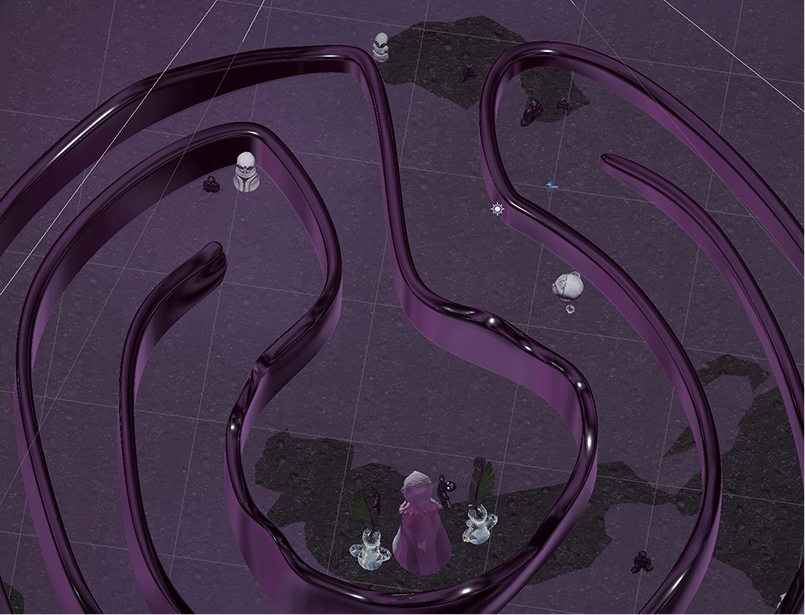
What objects, places, and figures make up your world? In this 10-week online intensive, you’ll learn 3D modeling in Blender while building a personal cosmogram, an interactive 3D scene that gathers and expresses your own worldview. You’ll use photogrammetry to turn photos of objects and people into 3D models, model and texture additional objects in Blender, and animate your models using AI assistance in Mixamo. Finally, you’ll assemble your world in New Art City or Unity to share it online.
Each week balances technical skill-building with creative development, culminating in a final project that is equal parts artwork and personal statement. A guest practitioner working in decolonial XR, Mayowa Tomori, will join the course to deepen our understanding of 3D scanning as a tool for research, preservation, and self-representation.
This course is for artists, designers, and technologists who want to learn Blender from the ground up while making something that genuinely matters to them. No prior 3D experience required.
Course Logistics
Enrollment Deadline: July 1, 2026
Dates:
Every Saturday
July 11 – September 12, 2026
Times:
10 AM – 1 PM PT | 1 PM – 4 PM ET
Location: Online
Cost:
- $1500 for Live Online Access
- $750 for Audit Access (weekly recording access, released after each session)
- Payment plans available: 3 monthly installments. Email [email protected] for more information.
Scholarship: We also offer Diversity Scholarships.
Apply by June 24, 2026. Scholarship notifications will be sent within 1 week after the deadline.
Experience Level: Beginner
Requirements:
Students should have access to a PC or Mac capable of running Blender, and a smartphone (iOS or Android) for photogrammetry exercises.
Prerequisites:
No prior 3D experience required.
Additional Information:
• No Refunds or Exchanges.
• View our FAQ here.
• Contact [email protected] with any questions.
Educational Goals:
By the end of this course, students will:
- Have a working foundation in Blender, including modeling, texturing, lighting, and importing external assets
- Understand photogrammetry as a creative and research tool, with hands-on experience using Scaniverse to capture objects and people
- Be able to rig and animate a humanoid figure using Mixamo and integrate it into a Blender scene
- Have assembled a complete, visitable 3D world using New Art City or Unity
- Have developed a personal creative practice around 3D as a medium for meaning-making and self-expression
- Have encountered critical perspectives on 3D scanning and XR as tools for research, preservation, and decolonial practice
Course Outline
This 10-week online intensive meets once weekly for 3 hours. Each session is self-contained: optional Blender tutorials are provided weekly as a resource for students who want to go deeper between classes. In-class time is for creative development, live demos, troubleshooting, and project work.
- Week 1 – July 11, 2026
Introduction to cosmograms and Blender orientation - Week 2 – July 18, 2026
Core modeling techniques; world inventory - Week 3 – July 25, 2026
Photogrammetry with Scaniverse; guest session with Mayowa Tomori - Week 4 – August 1, 2026
Mesh cleaning in Blender; Mixamo rigging and animation - Week 5 – August 8, 2026
Materials and lighting in Blender; intro to scene building in output platforms (New Art City and Unity); review of project proposals - Week 6 – August 15, 2026
Asset development; importing models for scene building in output platforms - Week 7 – August 22, 2026
Texturing; 3D model refinement; scene iteration - Week 8 – August 29, 2026
Scene assembly; lighting and atmosphere - Week 9 – September 5, 2026
Final project peer critique and feedback session - Week 10 – September 12, 2026
Final presentations; online public showcase
About Technologies:
Blender — Blender is a free and open-source 3D creation suite supporting the full pipeline of modeling, rigging, animation, simulation, rendering, compositing, and motion tracking. It is widely used by artists, designers, and studios worldwide and has become the industry standard for accessible, professional-grade 3D work. No license or subscription required.
Scaniverse — Scaniverse is a free mobile app for iOS and Android that uses LiDAR and photogrammetry to capture real-world objects and spaces as 3D models. It is used by artists, researchers, and designers for everything from object preservation to self-portraiture. Scans can be exported in standard formats compatible with Blender.
Mixamo — Mixamo is a free web-based tool by Adobe that allows users to auto-rig and animate humanoid 3D characters. It requires no manual rigging knowledge and supports direct export to Blender. It is widely used in game development, animation, and interactive art.
New Art City — New Art City is a free browser-based platform for building and sharing interactive 3D environments. Designed specifically for artists, it allows users to create visitable digital spaces without coding and share them via a simple link. It is the primary output platform for this course.
Unity (optional) — Unity is a real-time 3D development platform widely used for games, interactive installations, and immersive experiences. Students whose final projects require more complex interactivity or AR output may choose Unity as their output platform.
Become a Gray Area Member for early access to our workshops and courses, and up to 20% off.
Gray Area Members enjoy extraordinary access to our interdisciplinary arts & education programs, while supporting our mission to catalyze creative action for social transformation. Get free admission, exclusive content, and more!
