Primavera De Filippi
Metal, welding, blockchain
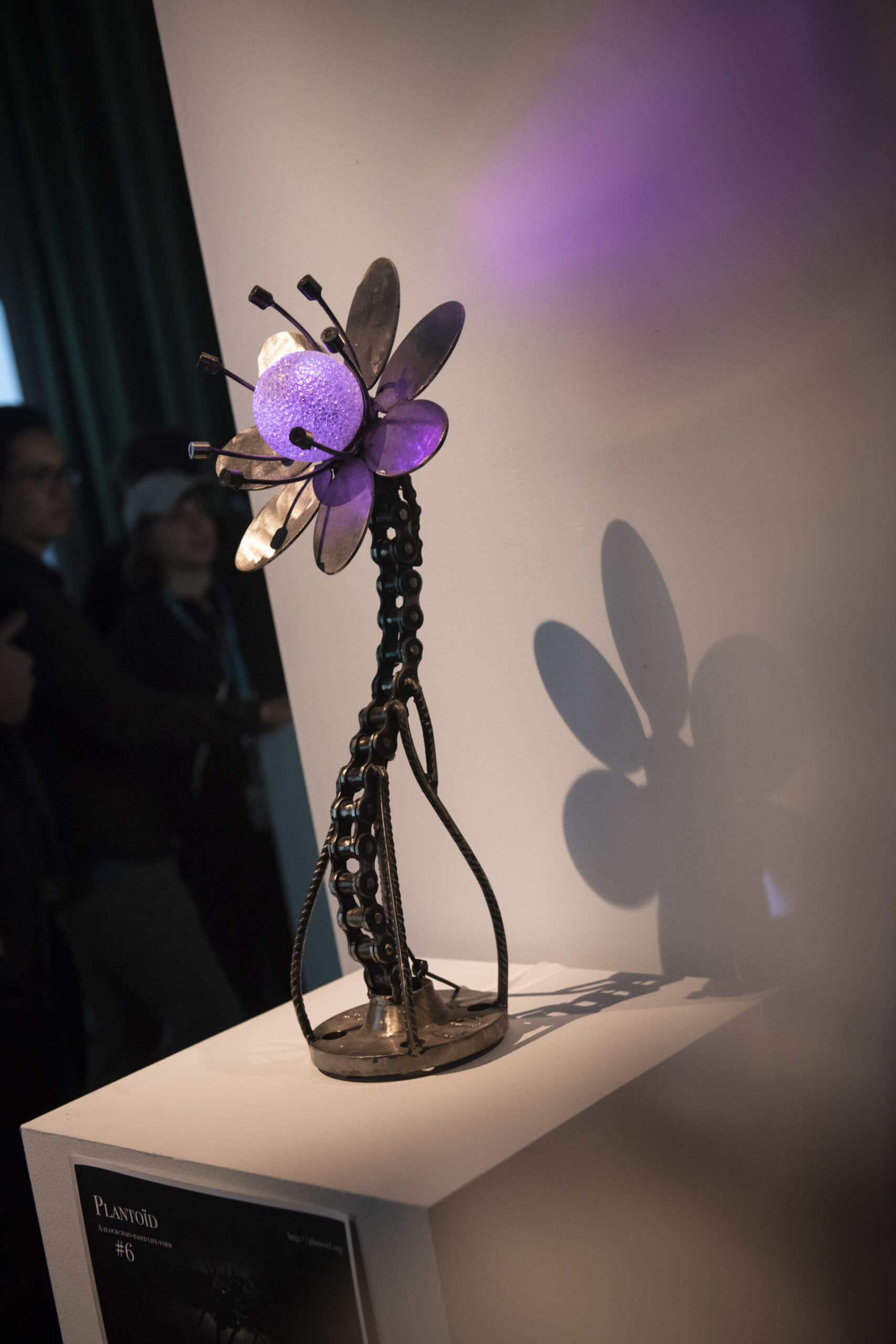
A Plantoid is the plant equivalent of an android; it is a robot or synthetic organism designed to look, act and grow like a plant.
There are currently several species of Plantoids in existence around the world.
This particular species of a Plantoid is an autonomous blockchain-based lifeform that is able to reproduce itself. It is a hybrid creature that lives both in the physical world (as a mechanical contraption made up of recycled steel and electronics) and in digital world (as a software deployed on top of a blockchain-based network).
The goal of the Plantoid is to illustrate one of the most revolutionary—and yet still unexplored—aspects of blockchain technology. It illustrates the ability to create “blockchain-based lifeforms”, i.e. algorithmic entities that are:
autonomous,
self-sustainable, and
capable of reproducing themselves,
through a combination of blockchain-based code and human interactions.
These new types of entities are difficult to apprehend for most people.
Blockchains are decentralized peer-to-peer networks, like Bitcoin, that enable people from all over the world to interact, coordinate, and transact value with one another in a secure and decentralized way. Software code can be deployed on a blockchain-based network to create programs (a.k.a smart contracts) that are run in a distributed manner by all nodes supporting the network. As opposed to traditional software code, run on centralized servers and administered by an online operator, smart contracts can be designed to run autonomously, independently of any central authority or middlemen.
The Plantoid is an attempt at using the artistic medium to illustrate the inner workings of these autonomous systems, so that people can better understand the potential benefits and challenges of this powerful, emergent technology.
View the work on Bloomberg Connects